

 2025-09-22
i-CABLE News 2025-09-18
Volunteers: People in society still support them and have not abandoned them.
As night falls on the streets of Hong Kong, a group of volunteers quietly crisscross the city, Kowloon, and the New Territories, collecting leftover bread and lunch boxes from shops and distributing them to the homeless, scavengers, and low-income individuals. However, with reduced funding and a shortage of volunteers, the campaign faces challenges. Some groups are calling on the government to institutionalise the Food Wise Campaign and promote cross-departmental collaboration and community engagement.
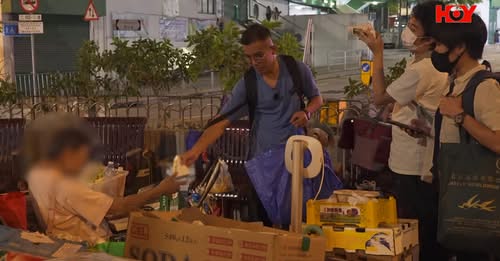
Volunteers' midnight actions collect leftover food and deliver it to the grassroots.
Volunteers from the Food Commons Foundation visit different areas weekly, collecting and donating food to those in need. A film crew recently followed the volunteers, documenting their food collection and distribution efforts in Hung Hom and To Kwa Wan. At 8 p.m. that evening, the volunteers arrived at two shops in Hung Hom, having contacted the stores in advance to confirm the amount of leftover food. Volunteer Eden presented her electronic volunteer card to the store staff and collected approximately 36 loaves of bread and lunch boxes, placing them in reusable and insulated bags. After counting and weighing the items, she then traveled by bus to To Kwa Wan for distribution.
The first stop was under the flyover, where volunteers handed out sandwiches and lunch boxes to street inhabitants. "They get it every week, which is fantastic. It helps since I save some. I normally pick up paper for a living, so I can contribute." Volunteers will also go to the waste station to give meals to cleaners and scavengers," said Ms. Kwok, who benefited. Ching Jae: "Of course, it's beneficial to have more volunteers. There's something to eat, something to give away, and sometimes you may express your rage. "It's better to say something than nothing."
Volunteer Eden stated that the handout was mostly aimed for street residents and low-income individuals, such as cleaners. When distributing, they pay attention to respect and will silently place food in front of street persons who refuse to exchange or take assistance. "I don't go out of my way to force, in fact, many volunteers insist on participating, often seeing the results, some people initially resist, to slowly accept, slowly share a little more."
Over the past decade, over 10,000 tons of food have been recycled, benefiting nearly 10 million people.
Carol Kwok, Project Manager of the "Food Commons Foundation," explained that the organization's goal is to "Save Food" by reducing waste, protecting the environment, helping those in need, and creating green jobs and volunteer opportunities. Over the past decade, the fund has recycled over 10,000 tons of food, benefiting nearly 10 million people, including bread, lunch boxes, and fruit and vegetables. However, due to a lack of funding, fruit and vegetable recycling continues only at markets in the Sha Tin District; programs in other areas have been suspended.
Eden admits that food recycling is facing multiple challenges. First, there's a decline in store donations, fearing that improper food handling could lead to spoilage, turning a good thing into a bad one. Second, a shortage of volunteers makes it difficult to cope with the heavy workload, exacerbating operational challenges.
Funding difficulties have become a barrier; we are hoping for entrenched government support.
The Food Common Foundation's operations are mostly supported by government and commercial grants, but grant applications have become more challenging in recent years, according to Carol Kwok. The Environment and Conservation Fund is the primary source of funding, although the application requirements state that each project's funding tenure is normally no more than two years and can be extended up to two years, for a total of four years, which does not allow for long-term operations. Kwok Hui Ling: "Ours are essential life items, not gimmick items. It's quite simple. We deal with problems with the least amount of personnel, material resources, and resources possible while making the best use of available resources."
She sees the recycling of food and sharing as a "infrastructure project" comparable to street cleaning. It is a government-mandated expenditure that should be institutionalised rather than depending on periodic fund applications. She proposed that the government secure the sustainability of food-saving efforts through cross-board coordination, tendering, or extending the period of the Environmental Protection Fund. "I want the government to have a consistent approach so that events can be sustained, rather than unsustainable as it is now and make people feel that it is not necessary."
Despite the difficulties, volunteers strongly believe in the need of food-saving initiatives. Eden stated that food distribution not only relieves the economic strain on the grassroots, but it also socially bonds them and allows them to feel cared for. "Let them know that there are still people in society who are willing to care and support them, so that they understand that they are not left out of society."
78 HOY Infotainment: <City Focus>
Air Dates: Monday to Friday
Time: 8:00 PM, Channel 77 premieres, 8:30 PM, Channel 78 repeats
WhatsApp Hotline: 68960931
Rewatch the show: > https://hoy.tv/title?id=9444 Episode 837, September 16, 2025